





What Is the Business Cycle?Complete Guide (2026)
Last Updated: November 4, 2026
Disclosure: This article is independent educational content. It contains no affiliate links or sponsored placements.
Editorial note: Historical economic dates and statistics are supported by publications from the National Bureau of Economic Research (NBER), the Bureau of Labor Statistics (BLS), and other official economic data sources.
What Is the Business Cycle?
What is the business cycle? The business cycle is the recurring pattern of expansion and contraction in economic activity over time. It describes how an economy moves through periods of growth, reaches a high point, experiences a slowdown, and eventually begins recovering.
During economic expansion, businesses generally increase production, employment opportunities improve, and consumers spend more money. During contraction, economic activity declines, businesses may reduce investment, and unemployment can rise.
Understanding the business cycle is important because economic changes affect business revenue, employment, borrowing costs, consumer confidence, and investment decisions.
According to the National Bureau of Economic Research (NBER), the United States has experienced expansions lasting more than ten years and recessions lasting only two months.
These differences demonstrate that business cycles do not follow a fixed schedule.
For business owners, understanding economic cycles can help with financial planning, inventory management, hiring decisions, and preparing for unexpected changes in customer demand.
In this guide, you will learn:
- What the business cycle means in economics.
- The four main phases of the business cycle.
- What happens during recovery, prosperity, peak, and trough.
- How to understand a business cycle diagram.
- What causes economic expansions and contractions.
- Real examples from American economic history.
- How businesses can prepare for economic uncertainty.
What Is the Business Cycle in Economics?
In economics, the business cycle refers to fluctuations in overall economic activity, including production, employment, income, and spending.
Economists also call it the economic cycle or trade cycle.
These fluctuations occur around the economy’s long-term growth path.
For example, an economy may grow over several decades while still experiencing temporary recessions and periods of slower growth.
A simple way to understand the business cycle is to imagine waves moving across the ocean.
The overall direction of the tide represents long-term economic growth, while the waves represent shorter periods of expansion and contraction.
What Are the Business Cycles?
What are the business cycles? They are recurring periods of increasing and decreasing economic activity.
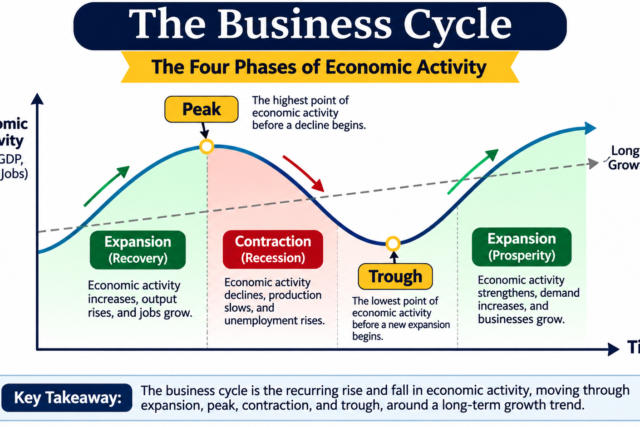
Each cycle includes four main phases:
- Expansion
- Peak
- Contraction
- Trough
These phases explain how an economy moves from growth to decline and eventually returns to growth.
However, business cycles are not identical. Their duration, intensity, and causes can vary significantly.
Some expansions continue for many years, while others end relatively quickly.
What Are the Components of the Business Cycle?
The components of the business cycle include several economic indicators that help economists evaluate economic conditions.
Real Gross Domestic Product (GDP)
Real GDP measures the value of goods and services produced in an economy after adjusting for inflation.
Increasing real GDP generally indicates economic growth, while declining real GDP may indicate economic weakness.
Employment and unemployment
Employment data help explain how economic conditions affect workers.
During expansion, businesses generally hire more employees. During contraction, hiring may slow and unemployment may increase.
Industrial production
Industrial production measures output from manufacturing, mining, and utilities.
Changes in production can provide important information about economic activity.
Consumer spending
Consumer spending is a major driver of economic activity.
When households increase spending, businesses may experience stronger demand.
When consumers reduce spending, companies may face declining revenue.
Real personal income
Real personal income helps economists understand changes in household purchasing power after accounting for inflation.
The NBER considers several indicators when identifying economic turning points rather than relying on GDP alone.
The Four Phases of the Business Cycle Explained
The phases of business cycle in economics explain how economic activity changes over time.
The four phases are expansion, peak, contraction, and trough.
Recovery and prosperity are also commonly discussed, but they describe different conditions within an expansion rather than additional official turning points.
1. Expansion: Economic Growth and Recovery
Expansion is the period when overall economic activity increases.
Businesses produce more goods and services, consumer demand generally improves, and employment opportunities may increase.
Recovery in a business cycle refers to the early part of an expansion following a trough.
During recovery, businesses may gradually increase production and investment as economic conditions improve.
Common signs of expansion include:
- Increasing GDP.
- Improving employment.
- Rising consumer spending.
- Stronger business investment.
- Improving consumer confidence.
However, economic recovery does not happen equally across all industries.
Some businesses may recover quickly, while others continue experiencing financial challenges.
2. Peak: The Highest Point of Economic Activity
A peak in business cycle analysis represents the highest point of economic activity before a contraction begins.
During the later stages of an expansion, businesses may experience strong demand, high production, and increased employment.
This period is sometimes associated with prosperity.
Prosperity in a business cycle describes relatively strong economic conditions, including healthy business activity, consumer spending, and employment.
However, strong growth can also create economic risks.
For example, increasing demand may contribute to inflation, while excessive borrowing can make businesses more vulnerable to changing financial conditions.
A peak marks the end of an expansion and the beginning of a contraction.
Economists generally identify peaks after examining economic data rather than predicting them precisely in advance.
3. Contraction: Economic Activity Declines
Contraction occurs when overall economic activity decreases after a peak.
During this phase, businesses may experience weaker sales, reduced production, and declining investment.
Companies may respond by limiting hiring, reducing expenses, or postponing expansion plans.
Common signs of contraction include:
- Declining economic output.
- Lower consumer spending.
- Reduced business investment.
- Slower hiring.
- Rising unemployment.
- Weakening consumer confidence.
A significant, widespread decline in economic activity is called a recession.
The NBER explains that a recession generally involves a substantial decline in economic activity spread across the economy and lasting more than a few months.
Importantly, two consecutive quarters of declining GDP are not the sole official test used by the NBER.
4. Trough: The Lowest Point of the Business Cycle
A trough in a business cycle is the lowest point of economic activity before a new expansion begins.
At this stage, businesses may still experience weak demand, high unemployment, and financial uncertainty.
However, economic activity eventually begins improving.
The trough business cycle turning point marks the end of contraction and the beginning of recovery.
A trough does not necessarily mean that employment, business profits, or household income immediately return to their previous levels.
For example, the US economy reached a trough in June 2009, according to the NBER.
However, the committee did not announce that turning point until September 20, 2010.
This demonstrates why economic turning points can be difficult to recognize while they are happening.
Diagram of a Business Cycle
A diagram of a business cycle helps explain how economic activity rises and falls over time.
The horizontal axis generally represents time, while the vertical axis represents economic activity.
A typical diagram shows a curved line moving through expansion, peak, contraction, and trough.
How to Read a Business Cycle Diagram
Step 1: Identify expansion
Expansion is represented by the upward movement of economic activity.
During this period, production, spending, and employment generally improve.
Step 2: Locate the peak
The peak represents the highest point before economic activity begins declining.
Step 3: Follow contraction
Contraction is represented by the downward movement from the peak toward the trough.
Step 4: Identify the trough
The trough marks the lowest point of economic activity before a new expansion begins.
Step 5: Follow the recovery
After the trough, economic activity begins increasing again.
This creates the recurring pattern shown in business cycle diagrams.
Why the Business Cycle Diagram Matters
The diagram helps students, business owners, and investors understand that economic growth is not constant.
Even economies with strong long-term growth can experience recessions and temporary periods of declining production.
However, the diagram is a simplified educational model.
Actual economic activity does not follow perfectly smooth or predictable waves.
What Causes the Business Cycle?
Business cycles develop because of changes in economic demand, investment, credit conditions, government policies, and unexpected events.
Several factors can influence economic expansion and contraction.
Changes in Consumer Spending
Consumer spending affects demand for goods and services.
When households spend more money, businesses may increase production and hiring.
When consumers reduce spending, businesses may experience lower revenue and reduce investment.
Changes in Interest Rates
Interest rates influence borrowing costs for businesses and consumers.
Higher interest rates can make loans more expensive, potentially reducing spending and investment.
Lower interest rates can encourage borrowing and economic activity, although their effects depend on broader economic conditions.
Business Investment
Companies invest in equipment, technology, buildings, and employees when they expect future demand to increase.
If business confidence declines, companies may postpone these investments.
Reduced investment can contribute to slower economic growth.
Government and Monetary Policies
Government spending, taxation, and central bank policies can influence economic activity.
For example, central banks may adjust interest rates to support price stability and broader economic objectives.
However, economic policy cannot eliminate every recession or guarantee continuous growth.
Unexpected Economic Shocks
Unexpected events can disrupt economic activity.
Examples include:
- Pandemics.
- Financial crises.
- Major energy price changes.
- Supply chain disruptions.
- Natural disasters.
- International conflicts.
These events can affect production, consumer confidence, and business investment.
Why the Business Cycle Matters for Businesses
Understanding the business cycle helps business owners recognize how economic conditions can influence their operations.
Although no business can predict every economic turning point, financial preparation can reduce exposure to unexpected challenges.
Business Revenue and Customer Demand
During expansion, customers may have greater confidence and purchasing power.
Businesses may experience stronger demand for products and services.
During contraction, customers may reduce discretionary spending.
Companies that depend heavily on nonessential purchases may experience greater pressure.
Hiring and Employment Decisions
Economic conditions influence hiring decisions.
Businesses may increase their workforce during periods of strong demand.
However, when economic activity slows, companies may postpone hiring or reduce labor expenses.
Business owners should consider both current revenue and long-term financial sustainability before expanding their workforce.
Borrowing and Business Expansion
Borrowing can help companies finance growth, but excessive debt creates financial risk.
A business that takes on substantial debt during an expansion may struggle if sales decline during a recession.
Understanding economic conditions can help owners evaluate borrowing decisions more carefully.
For additional guidance on business planning and professional advice, read our article on what a business consultant does.
Financial Planning and Cash Flow
Cash flow management is important during every stage of the business cycle.
Companies should regularly review:
- Operating expenses.
- Loan repayments.
- Cash reserves.
- Customer payment patterns.
- Inventory costs.
- Expected revenue.
Strong financial planning can help businesses remain more resilient during economic downturns.
How Business Cycles Affect Employment and Unemployment
Employment and unemployment are closely connected to economic activity.
During expansion, businesses generally experience increasing demand and may hire additional employees.
During contraction, businesses may reduce hiring or eliminate positions.
This relationship helps explain unemployment and business cycles.
What Is Cyclical Unemployment?
Cyclical unemployment occurs when workers lose jobs because of declining economic demand.
For example, imagine a furniture manufacturer experiencing falling sales during a recession.
If the company reduces production and lays off employees, those job losses may be classified as cyclical unemployment.
As economic demand improves, the manufacturer may eventually increase production and hire workers again.
However, unemployment can remain elevated even after the economy begins recovering.
Real Example: The Great Recession
During the Great Recession, unemployment increased significantly in the United States.
According to historical data from the Bureau of Labor Statistics, the unemployment rate reached 10 percent in October 2009.
This occurred after the recession had officially ended in June 2009.
The example demonstrates that employment recovery can lag behind improvements in overall economic activity.
Business Cycle Phases Compared
The following table summarizes the major characteristics of the business cycle.
| Phase | Economic Activity | Employment | Business Considerations |
|---|---|---|---|
| Expansion | Increasing | Generally improving | Manage growth and investment |
| Peak | Reaches a high point | Often relatively strong | Review financial risks |
| Contraction | Declining | Hiring may slow | Protect cash flow |
| Trough | Reaches a low point | May remain weak | Prepare for recovery |
Important: Recovery and prosperity describe conditions within expansion. They are not additional official phases in the four-stage model.
Real-World Examples of Business Cycles
Historical examples demonstrate how business cycles can differ in duration and severity.
The Great Depression (1929–1933)
The Great Depression was one of the most severe economic downturns in American history.
According to the NBER, the US economy reached a peak in August 1929 and a trough in March 1933.
The contraction lasted 43 months.
During this period, economic production declined sharply, unemployment increased dramatically, and many financial institutions failed.
The Great Depression illustrates how a severe contraction can create long-lasting economic and social consequences.
The Great Recession (2007–2009)
The Great Recession began after the US economy reached a peak in December 2007.
The NBER identified June 2009 as the trough.
The contraction lasted 18 months.
The downturn was associated with major problems in housing and financial markets, declining economic activity, and substantial job losses.
The expansion that followed lasted 128 months, from June 2009 to February 2020.
According to the NBER chronology, this was the longest US economic expansion on record.
The 2020 Recession
The COVID-19 pandemic caused a sudden disruption in economic activity.
The NBER identified February 2020 as the peak and April 2020 as the trough.
The recession lasted only two months, making it the shortest recession in the NBER’s US chronology.
However, the short duration did not mean the economic consequences were minor.
Businesses experienced closures, employment declined sharply, and supply chains faced disruptions.
This example shows that unexpected events can create sudden economic contractions.
How Long Does a Business Cycle Last?
There is no fixed duration for a business cycle.
Some economic expansions last only a few years, while others continue for more than a decade.
Historical NBER data for 1945–2020 show the following averages:
| Measurement | Average Duration |
|---|---|
| Expansion | 64.2 months |
| Contraction | 10.3 months |
| Complete cycle, trough to trough | 74.5 months |
Based on these historical averages, expansions account for approximately 86 percent of the combined expansion and contraction duration.
This means the US economy historically spent considerably more time expanding than contracting during this period.
However, these averages should not be used to predict when the next recession will occur.
Business cycles do not follow a fixed timetable.
For historical dates and official recession information, visit the NBER Business Cycle Expansions and Contractions database.
Common Business Cycle Mistakes to Avoid
Understanding economic cycles can help businesses avoid several common planning mistakes.
Mistake 1: Assuming Economic Growth Will Continue Forever
Strong sales and rising profits can create excessive confidence.
Some businesses respond by borrowing heavily or expanding too quickly.
However, economic conditions can change unexpectedly.
Businesses should evaluate potential risks before making major financial commitments.
Mistake 2: Ignoring Cash Flow
A company may generate strong revenue but still experience financial difficulties if expenses and debt payments are too high.
Maintaining cash reserves and controlling operating costs can improve financial resilience.
Mistake 3: Treating Every Slowdown as a Recession
A temporary decline in sales does not necessarily mean the entire economy is entering a recession.
Business performance can be influenced by competition, seasonal demand, management decisions, and industry-specific conditions.
A recession involves a broader decline in economic activity.
Mistake 4: Trying to Predict Every Peak and Trough
Economic turning points are difficult to identify in real time.
Even professional economists often recognize peaks and troughs after examining historical data.
Businesses should focus on preparation rather than attempting to predict exact economic turning points.
Practical Strategies for Managing Business Cycle Changes
Business owners can use economic information to improve planning and reduce financial risks.
1. Build Financial Reserves
Maintaining adequate cash reserves can help cover operating expenses during periods of declining revenue.
The appropriate reserve amount depends on business expenses, financial obligations, and industry conditions.
2. Monitor Economic Indicators
Regularly review economic indicators such as:
- GDP growth.
- Inflation.
- Interest rates.
- Employment.
- Consumer spending.
- Business investment.
The Federal Reserve Economic Data (FRED) database provides useful economic charts and historical data.
3. Manage Debt Carefully
Businesses should evaluate borrowing costs and repayment obligations before taking on additional debt.
Excessive borrowing can create financial pressure when customer demand weakens.
4. Improve Operational Efficiency
Reviewing expenses, improving inventory management, and reducing unnecessary costs can strengthen business operations.
These improvements are valuable during both economic expansion and contraction.
5. Evaluate Long-Term Business Value
Economic conditions can influence business profitability and valuation.
Companies with reliable cash flow, manageable debt, and diversified revenue sources may be better positioned to handle changing economic conditions.
To learn more about business valuation, read our guide on how much a business is worth.
Frequently Asked Questions About the Business Cycle
What is the business cycle?
The business cycle is the recurring pattern of expansion and contraction in economic activity. It includes four main phases: expansion, peak, contraction, and trough.
What are the business cycles?
Business cycles are recurring periods of economic growth and decline. They influence production, employment, income, consumer spending, and business investment.
What are the four phases of the business cycle?
The four phases are expansion, peak, contraction, and trough. Recovery and prosperity describe different conditions within an expansion.
What is a trough in a business cycle?
A trough is the lowest point of economic activity before a new expansion begins. It marks the end of a contraction, although unemployment and other economic difficulties may continue.
What is a peak in a business cycle?
A peak is the highest point of economic activity before a contraction begins. It marks the end of an expansion.
What is recovery in a business cycle?
Recovery is the early stage of expansion following a trough. During recovery, production, employment, and consumer spending generally begin improving.
What is prosperity in a business cycle?
Prosperity describes a period of relatively strong economic growth, employment, consumer demand, and business activity during an expansion.
What causes the business cycle?
Business cycles can be influenced by consumer spending, investment, interest rates, government policies, credit conditions, and unexpected economic shocks.
How long does a business cycle last?
There is no fixed duration. Historical US data from 1945–2020 show an average expansion of 64.2 months and an average contraction of 10.3 months, according to the NBER.
How does the business cycle affect businesses?
The business cycle influences revenue, customer demand, borrowing costs, hiring, and investment decisions. Businesses may experience stronger demand during expansion and greater financial pressure during contraction.
How can businesses prepare for a recession?
Businesses can prepare by maintaining cash reserves, managing debt, monitoring expenses, understanding customer demand, and improving operational efficiency.
Conclusion
What is the business cycle? It is the recurring pattern of economic expansion and contraction that affects businesses, workers, consumers, and investors.
Understanding the four phases of the business cycle helps explain why economic conditions change over time.
Expansion brings increasing economic activity. The peak marks the highest point before a downturn. Contraction represents declining activity, while the trough marks the beginning of a new expansion.
Three key takeaways:
- Business cycles repeat, but their timing and severity are unpredictable.
- Economic indicators such as GDP, employment, and consumer spending help explain changing conditions.
- Businesses that manage debt, maintain financial reserves, and monitor economic trends are better prepared for uncertainty.
The goal is not to predict every economic turning point. Instead, it is to understand how the economy changes and make informed decisions.
For business owners, students, and anyone interested in economics, understanding the business cycle provides a useful foundation for financial planning and long-term decision-making.
Sources and References
- National Bureau of Economic Research: US Business Cycle Expansions and Contractions
- NBER: Business Cycle Dating Procedure and Frequently Asked Questions
- US Bureau of Labor Statistics: The Recession of 2007–2009
- US Bureau of Economic Analysis: Gross Domestic Product
- Federal Reserve Bank of St. Louis: FRED Economic Data
Methodology: Historical business cycle dates and duration averages come from the NBER’s published chronology. The approximate 86 percent expansion figure is calculated from the 1945–2020 averages of 64.2 months of expansion and 10.3 months of contraction.
Disclaimer: This article provides general educational information and should not be considered personalized financial or investment advice.


One thought on “What Is the Business Cycle? Complete Guide (2026)”